Keywords Explained for Beginners (2025 Edition)
Introduction: The Word Everyone Keeps Mentioning

If you’ve heard anything about SEO, you’ve probably heard the word “keyword” at least a hundred times.
But what does it actually mean — and why does everyone keep talking about it?
The truth is, keywords are the foundation of SEO. They’re what connect people’s questions to your content.
Every search starts with a few words someone types into Google — words that describe exactly what they’re looking for.
Whether it’s “best phones under ₦200,000”, “how to cook jollof rice”, or “cheap hotels in London”, those words are keywords — and learning how to use them properly is the key to ranking online.
So, let’s break it down step by step.
Step 1: What Are Keywords (Really)?
Keywords are simply the words or phrases people type into search engines when they want to find something online.
For example:
- “best running shoes for beginners”
- “How to clean suede sneakers”
- “affordable birthday gift ideas for her”
Each of these phrases tells Google:
“Hey, show me something that matches what I’m looking for.”
So, if you create content that answers those searches better than anyone else, Google rewards you with visibility.
Think of keywords as questions, and your content as the answer.
That’s the simplest way to understand SEO.
Step 2: Why Keywords Matter So Much
Imagine owning a shop that sells handmade candles — but it’s located down a quiet street with no signs.
People might love your candles, but they’ll never find your store.
That’s what happens when you don’t use keywords.
They act as digital signposts that help Google understand what your page is about — so it can send the right visitors your way.
When used correctly, keywords can help you:
- Get more organic traffic (free visitors from search).
- Attract people who actually want what you offer.
- Understand your audience’s language, needs, and pain points.
In short: Keywords make sure your amazing content doesn’t stay hidden.
Step 3: Types of Keywords You Should Know
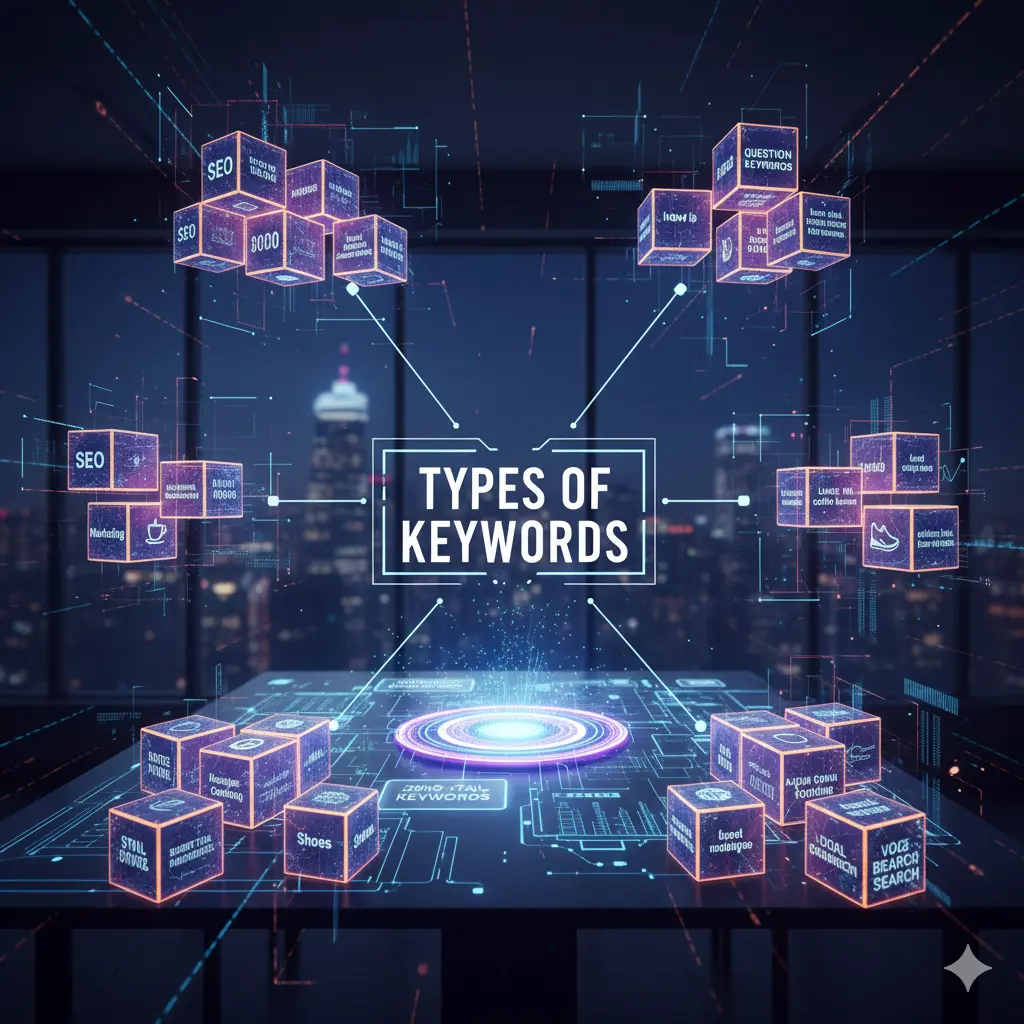
Not all keywords are the same. Different types serve different purposes — and understanding this helps you target smarter, not harder.
1. Short-Tail Keywords
These are one or two words long — like “shoes” or “SEO”.
They have high search volume but massive competition.
- Pros: Broad reach
- Cons: Very hard to rank for
Example:
“shoes” might get millions of searches, but big brands dominate that space.
2. Long-Tail Keywords
These are longer, more specific phrases (3–6 words).
Example: “best running shoes for flat feet” or “healthy breakfast ideas for kids.”
- Pros: Easier to rank and attract the right people
- Cons: Lower search volume individually (but higher conversion rate)
Tip: As a beginner, always start with long-tail keywords. You’ll grow faster with less competition.
3. Question Keywords
These usually start with how, what, why, when, or where.
Example:
- “How does SEO work?”
- “What is the best camera for YouTube beginners?”
They’re perfect for tutorials, listicles, and blog posts — because they directly match what people ask.
4. Branded vs. Non-Branded Keywords
- Branded: Include a company name, like “Nike Air Max 270.”
- Non-branded: Generic terms like “running shoes for men.”
If you run a business, aim for both — brand awareness (your name) and general discovery (your niche).
Step 4: Understanding Search Intent

Here’s where most beginners miss it.
Not every keyword means the same thing — even if the words look similar.
What matters is why someone is searching.
There are three main types of search intent:
1. Informational Intent
People want to learn something.
Example:
- “What is SEO?”
- “How to bake banana bread.”
You should create educational content — tutorials, blog posts, or explainer videos.
2. Transactional Intent
People want to buy something.
Example:
- “Buy Nike Air Force 1 size 42.”
- “Affordable web hosting plans.”
This is where product pages, reviews, and comparison posts shine.
3. Navigational Intent
People are looking for a specific site or brand.
Example:
- “YouTube login”
- “Scrubishly cleaning company Toronto”
Understanding intent helps you write the right kind of content for each keyword.
If you try to sell on an informational query, you’ll lose readers fast.
Rule of thumb: Match your content to what the user expects to see.
Step 5: How to Use Keywords Naturally
Now that you’ve found your keywords, here’s how to use them effectively.
1. Place Your Main Keyword in Key Spots
- Title
- First paragraph
- One or two subheadings (H2/H3)
- Meta description
- Image alt text
Example:
If your keyword is “best budget cameras for YouTube,”
Your title could be:
“7 Best Budget Cameras for YouTube Beginners (2025 Guide)”
Then sprinkle it naturally throughout your content.
2. Don’t Overdo It
This is called keyword stuffing — and it hurts your rankings.
Use variations (synonyms or related phrases) instead, like:
- “affordable YouTube cameras”
- “low-cost vlogging cameras”
3. Focus on Readability
If it doesn’t sound natural when you read it aloud, rephrase it.
Google is smart enough to understand context — you don’t need to repeat the same phrase endlessly.
Pro tip: Write for humans first, optimize for search second.
Step 6: Tools That Help You Find Keywords

You don’t need fancy software to start.
Here are a few free (and powerful) tools to help you discover keywords:
- Google Autocomplete: Type your topic into Google and note the suggestions.
- AnswerThePublic: See real questions people are asking.
- Ubersuggest: Get data on search volume and difficulty.
- Google Trends: Spot which keywords are rising or fading.
Combine insights from all four, and you’ll have a well-rounded list of keywords that balance popularity with ranking potential.
Step 7: The Secret to Winning with Keywords
The real secret isn’t just using keywords — it’s understanding your audience.
When you know what people struggle with, what they want, and how they talk, keywords come naturally.
- Write to solve problems.
- Use real-world examples.
- Keep your tone conversational and human.
Google’s 2025 algorithm focuses on helpfulness and trustworthiness — not just keyword count.
That means your voice, experience, and insight are what truly make you rank.
Common Keyword Mistakes Beginners Make
❌ Stuffing keywords unnaturally.
✅ Write smoothly. Google understands synonyms.
❌ Ignoring search intent.
✅ Always check what kind of content ranks for your keyword.
❌ Targeting overly competitive keywords.
✅ Start small, grow topical authority, then aim higher.
❌ Forgetting the meta description.
✅ It’s your mini ad — make it clickable.
❌ Neglecting updates.
✅ Refresh your posts every few months as trends shift.
FAQs
Q1: How many keywords should I target in one post?
One main keyword + two or three related ones is ideal.
Q2: Can I rank without using keywords?
No — keywords are how Google matches your content to user searches. But use them naturally.
Q3: Do hashtags count as keywords?
Not for SEO. Hashtags help on social media, not search engines.
Q4: Should I repeat my keyword in every paragraph?
No. Once or twice per section is fine if it fits naturally.
Q5: How long before my keywords start ranking?
Usually between 3–6 months for new websites, depending on competition and content quality.
Final Thoughts
Keywords are the bridge between your content and the people looking for it.
Once you understand how they work — and how to use them with purpose — you’ll start seeing SEO as a creative strategy, not a technical chore.
In 2025, SEO success belongs to those who create valuable, trustworthy content that directly answers real searches.
So the next time you write, start with a simple question:
“What is my audience searching for right now?”
Answer that — and you’ve just done SEO right.
Watch the Full Video
Want to see keywords explained visually with real examples?
Watch the full YouTube video here:
In this video, I show you exactly how keywords work, how to find them easily, and how to use them naturally — so you can start ranking your content without overthinking SEO.